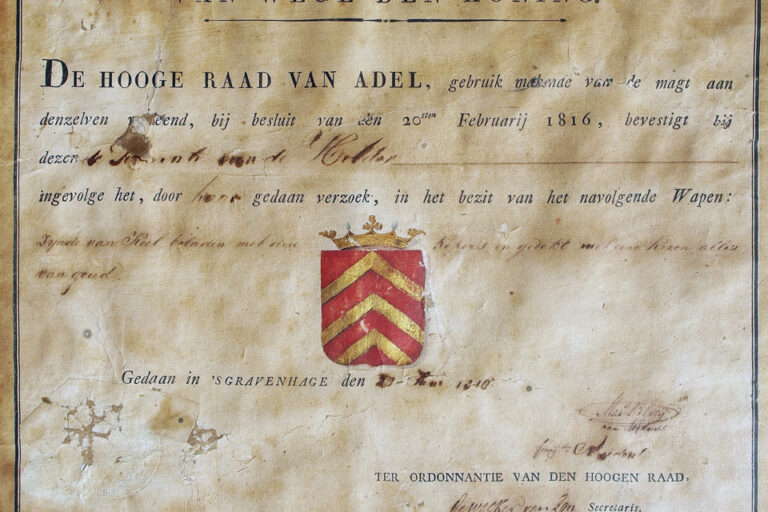
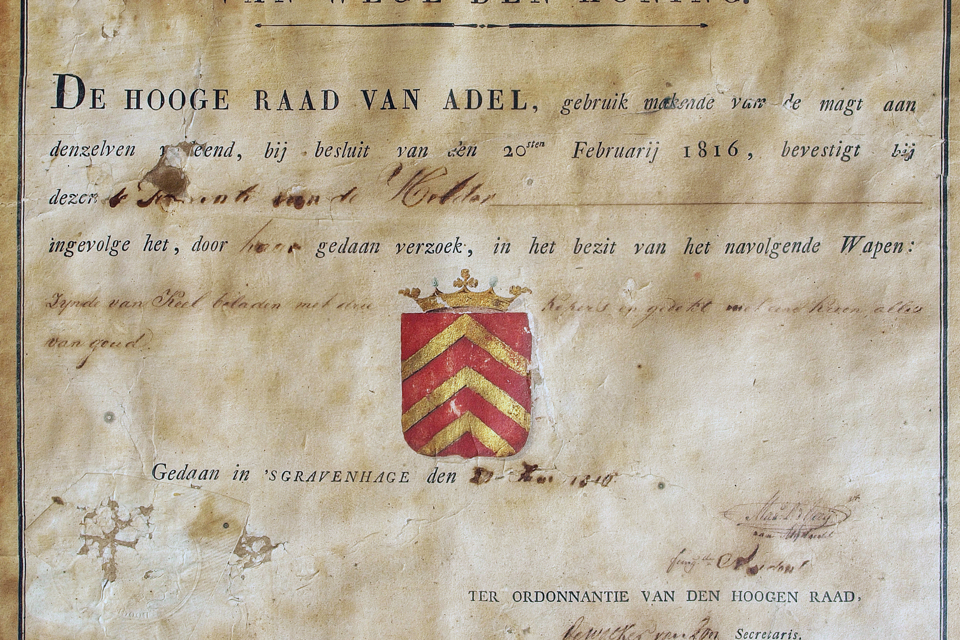
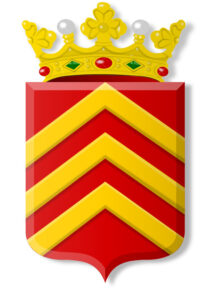
Three gold chevron finials on a red background, two pearls, two emeralds, and three rubies. This is the coat of arms of Den Helder, and it predates the city itself by many centuries. It is derived from the coat of arms of the lords and counts of Egmont, who were lords of Huisduinen in the late Middle Ages and held their hunting parties in the Grafelijkheidsduinen, named after them.
But the connection with Egmond goes back further. As early as the tenth and eleventh centuries, the Egmond Monastery, the first major religious center of the Northern Netherlands, had properties between Huisduinen and Callantsoog. Founded in 922 as a nunnery, by the year 1000 the abbey had become an economic powerhouse, owning land throughout the County of Holland and even beyond. This was partly because the unfree farmers surrounding this estate directly fed the monastery's storehouses with their harvests.
The village of Huisduinen had already existed for some time. The earliest mention of 'Husiduna' dates from 886. When Den Helder originated around 1500 as the fishing hamlet 'die Helder Buyrt' on the Marsdiep canal, Huisduinen had already moved inland several times due to the ongoing coastal loss.
The monks of Egmond Abbey were the first to battle the water on the North Holland coast and began building dikes to protect their lands south of the abbey. But on the coast, the loss of land was irreversible. During major storm surges in 1170 and 1196, the sea broke through the dune belt in several places. The peatland behind it was almost completely washed away. Callantsoog and Huisduinen remained as Wadden Islands, isolated on stretches of dune. Only four and five centuries later were they reconnected to the mainland with the construction of the Zijper Zeedijk and the Oldebarneveltsdijk.
The Abbey of Egmont lost a large portion of its landholdings in the Noordkop region during the disaster and withdrew from the area. The islands of Callantsoog and Huisduinen were subsequently granted as fiefs by the counts of Holland to some of their loyal followers: Callantsoog to the lords of Brederode and Huisduinen to the lords of Egmont. The Egmonts had begun simply as secular agents of the abbey, but had increasingly assumed independent power. From 1486 onward, they held the title of count.
The coat of arms was officially granted to the municipality of Den Helder by the High Council of Nobility on June 20, 1816. The coat of arms Den Helder bears is therefore a result of hunting expeditions in the Grafelijkheidsduinen by the Lords and Counts of Egmont.
Source: Canon of the Netherlands