
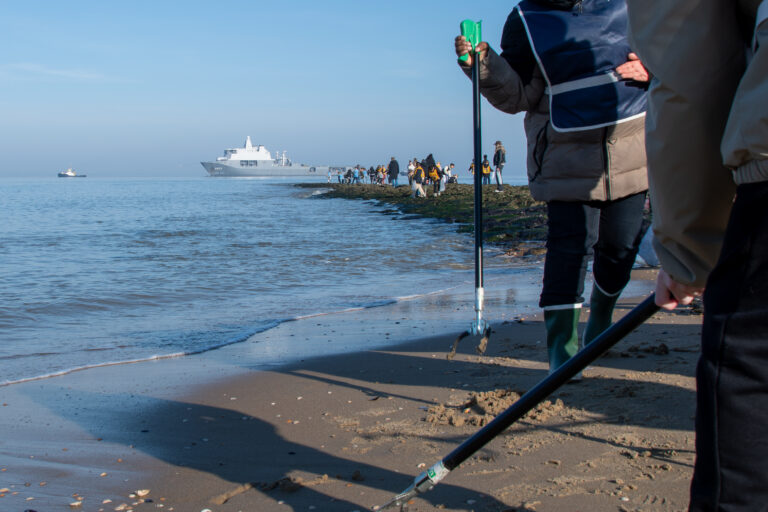
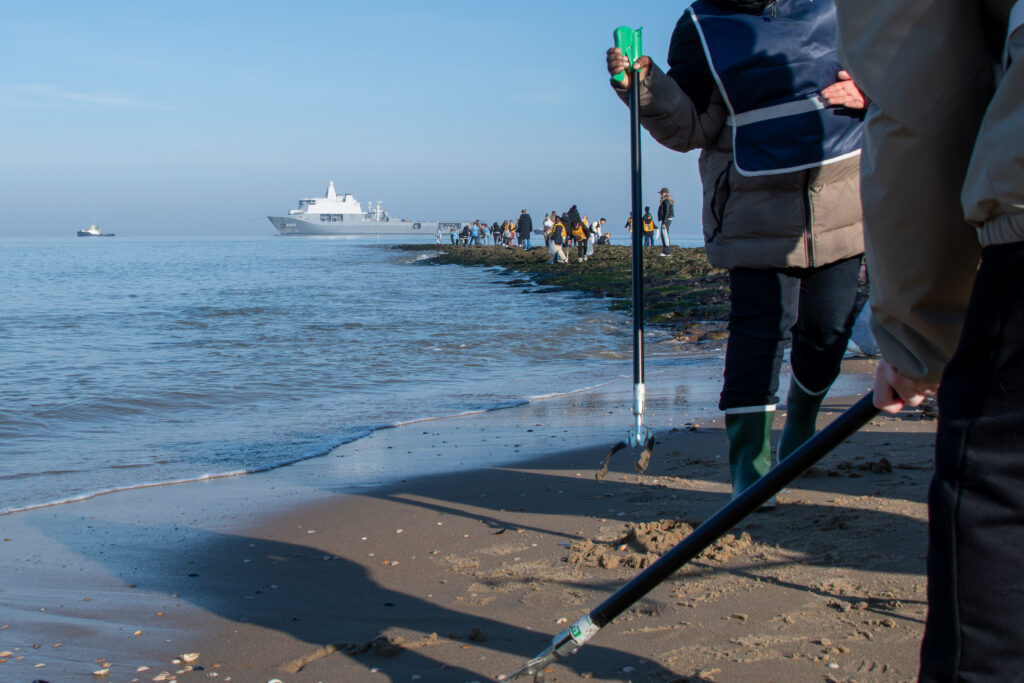
With grabbers in hand, they walked onto the beach. More than 600 pupils from groups 4 and 5 went beachcombing simultaneously in class Den Helder. At three locations along the coast, they collected what the sea had left behind.
It was a fast-paced morning. Music echoed across the beach, and in the sunlight, plastic, cans, wood, and rope disappeared into the bags one by one. In this way, the pupils discovered up close everything that washes up on their own beach.
The beachcombing campaign is part of the Blue Schools approach in Den Helder. Within this program, childcare, primary schools, secondary education, and vocational education collaborate on a continuous learning pathway centered on water. In this way, children learn step by step what the sea means to their environment.
It does not remain a standalone activity. Existing subjects are increasingly finding a place in the urban environment. Arithmetic, language, and technology are linked to themes such as the sea, harbor, and coast.
In Den Helder, that context is there for the taking. The city is surrounded by the sea on three sides, and with seven kilometers of beach, the coast is never far away.
The materials found on the beach are given a second life. Together with artist Lydia de Loos, the students transform their finds into artworks. From May 12, these can be seen during the Strandschatten exhibition in the Den Helder town hall.