The longing for Balistraat remained for generations.
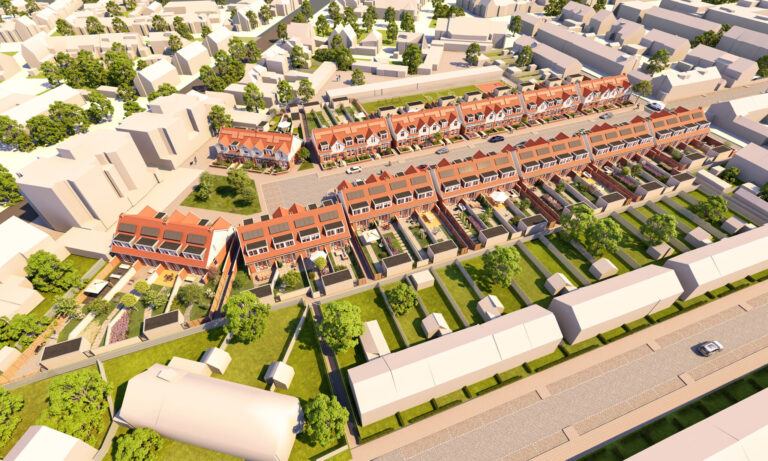
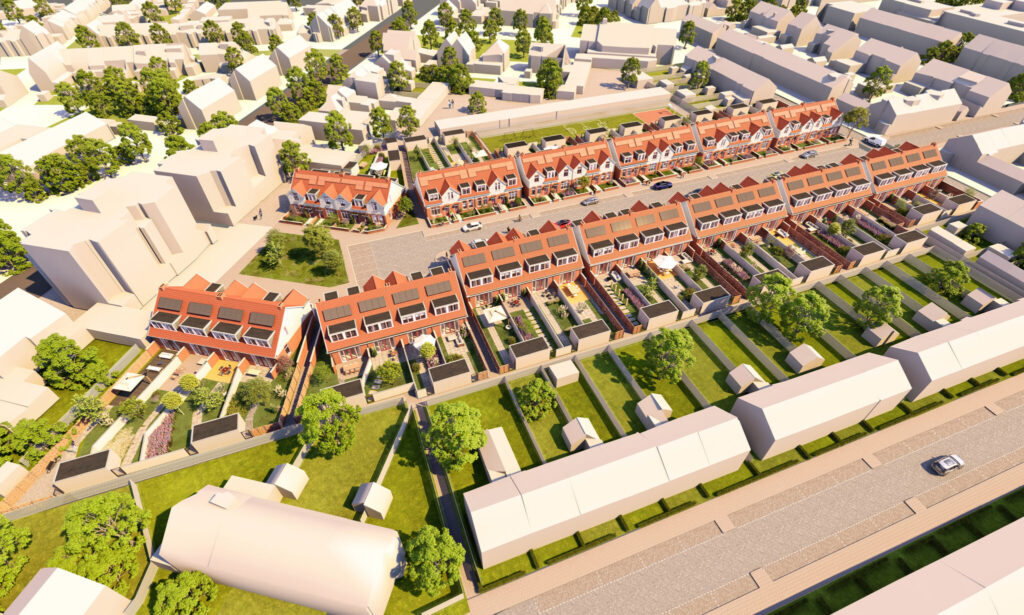
They were among the Housing Foundation's oldest properties. Last year they were demolished: the 52 workers' houses on Balistraat, dating from 1919-1920. An equal number of sustainable, more spacious houses will replace them. Entirely in the architectural style of yesteryear. Resident Anita Boelen can't wait to return to the street where five generations of her family lived. But Anne-Gé Zee-Van der Vaart isn't. "I'm happy where I am now."’
Neither Anita nor Anne-Gé has to think long about the question of what makes Balistraat so special. Anne-Gé lived there for 21 years and looks back with nostalgia at the conviviality that prevailed there. "And the sense of community. In good weather, life mainly took place outdoors, just as it used to be. People looked out for one another. If you had no food, they would give you their last loaf of bread."’
Dated
In the eyes of landlord Woningstichting, the homes were too small by current standards and dated in every respect. Major renovations, such as those in the 1970s, were no longer worthwhile and too costly in relation to the result. Therefore, construction company Dozy BV is now rebuilding 52 spacious homes on behalf of the corporation. They were designed by the renowned architectural firm Braaksma & Roos, which also designed the recently completed new-build homes at the head of Koningstraat.
The homes on Balistraat will soon meet all contemporary requirements for sustainability and comfort. Energy costs will be low for the new residents.
Sale
Of the 52 homes, twelve are going up for sale, because there is demand for that as well. And it brings some diversity to the street.
The Housing Foundation had drawn up a comprehensive social plan for the original residents of Balistraat. They could move temporarily or permanently to another home in Den Helder. Those wishing to return to Balistraat can choose between a home at the original location or one elsewhere in the street. Eighteen of the original tenants want to return to Balistraat regardless.
Birthplace
Anita Boelen makes up her mind quickly. She is going back too. "I lived on Balistraat for 36 years at a different house number, but I want to return to my childhood home. My mother continued to live there until her passing, so it would be wonderful to be able to return there now. It was just a very pleasant street."’
She is living temporarily on Anemonenstraat. "There's nothing wrong with it in itself, really, but I miss Balistraat."’
Entire generations have become attached to Balistraat. "In total, five generations of our family have lived there. Grandparents, parents, uncle and aunt, cousins, and myself." It is known that in other homes, that bond goes back up to three generations.
As mentioned, Anne-Gé Zee-Van der Vaart lived on Balistraat for 21 years, but is deliberately choosing not to return. "I currently live in an apartment on Hendrik Baskeweg, and although I had to get used to it a lot at first, I like it here now. Because of my health, it is nice to have everything on one level."’
Admiration
She is a woman with strong opinions and principles. She also absolutely disagreed with the Housing Foundation's decision to demolish the Balistraat. "What did they say the houses were small? Across the street from me, they were living in them with nine children!" At the same time, she is full of admiration for the building plan that the Housing Foundation is now realizing. "It looks really beautiful."’
Besides pragmatic reasons, she also has a matter of principle for not returning to Balistraat. "They are single-family homes with three bedrooms. Surely you shouldn't live there alone? A family belongs there! In any case, I think the Housing Foundation needs to be stricter about this."’
Greetings
Nevertheless, she is going to miss Balistraat. The sense of community and the social character were true hallmarks of the neighborhood, Anne-Gé explains. And that actually applies to the entire inner city. "I lived in the Stad binnen de Linie for 62 years. It seems as if the people there are different. For example, they greet each other much more often, even strangers. In De Schooten, everyone is much more withdrawn. When I say hello to people on the street, sometimes they don't say anything back. Or I hear: do we know each other? Then I answer: no, but now we do."’
That does not alter the fact that Anne-Gé has settled in at her new home after two years. "Oh yes, I feel at home here. When I moved to De Schooten two years ago, it was a culture shock. A completely different world. But by now I am settled. I am part of the pétanque club in the building and have good contact with many residents. So I have the deadline within which I had to indicate whether I wanted to return to Balistraat to expire."’