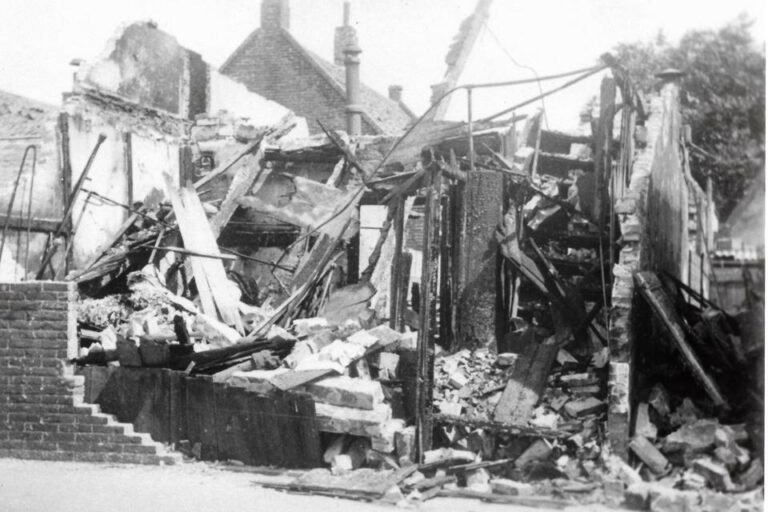
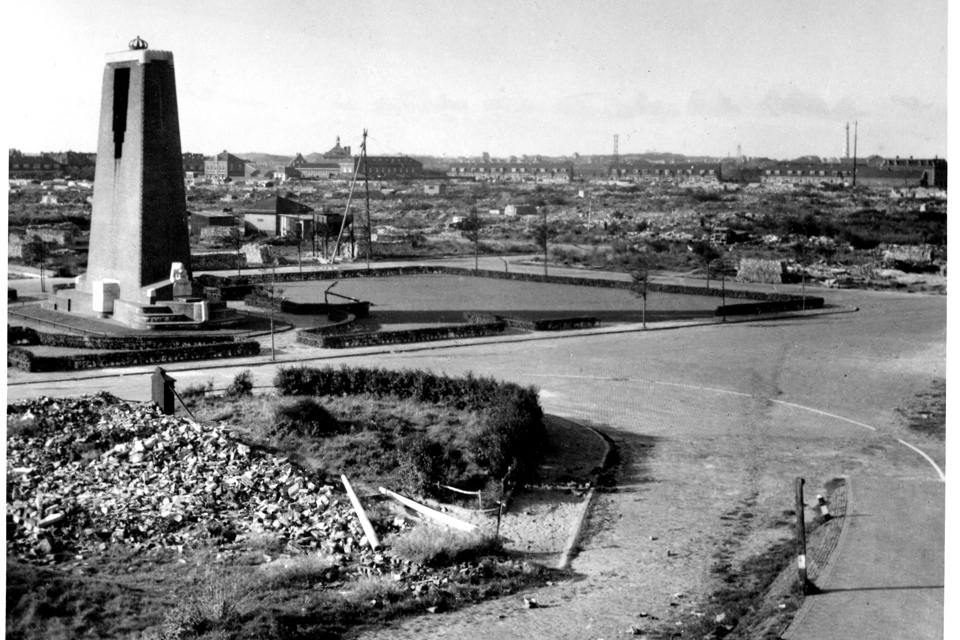
World War II officially began on May 10, 1940: the Netherlands and Belgium were attacked by the Germans. In Den Helder, the first days of the war were relatively mild until just after the Dutch surrender. Oh, and just a quick word about the Dutch surrender: in Stelling Den Helder, there was great surprise. We were winning, weren't we? Stelling commander Rear Admiral Jolles had everything under control; we were supreme. The enemy was defeated at the Afsluitdijk and ground to a halt. Why then surrender? Just after the surrender on Tuesday, May 14, around 8:00 PM, three German bombers attacked our city, dropping high-explosive bombs on the Kanaalweg, Buitenhaven, Rijkswerf, Fort Oostbatterij, Battery Wierhoofd, Stationsplein, Westgracht, Eerste Schagendwarsstraat, Kroonstraat, Parallelweg, Gravenstraat, Schagenstraat, Molenstraat, Weststraat, and Zuidstraat, among others. Many more bombings would follow on Den Helder, including the major bombing of June 24-25, 1940, during which the city was bombed for four hours and 38 people died that night. At the funeral service for the victims, then-mayor Govert Ritmeester promised a monument for these fallen soldiers. It wasn't until 2006 that this monument was finally erected in the general cemetery in Den Helder. Many more bombings would follow. How many? We still don't know exactly, but we can say that Den Helder was the most heavily bombed city in the Netherlands. And what about the population? Part of Den Helder was designated a restricted area, and fear and anxiety about new bombings led to a deserted city, and the population moved to the surrounding polders. Then there was also the German fear of an invasion of our coast. Approximately 1,900 homes disappeared, including the entire Oud Den Helder, Kanaalweg, Hoofdgracht, and part of Weststraat, to create a clear field of fire. The Jewish community also suffered immensely. 118 Helderse Jews were murdered in the camps and are commemorated with memorial stones in the streets where they lived and with a memorial unofficially unveiled on Koningsplein on October 15, 2020.
After the German capitulation on May 5, 1945, we were liberated, but many had lost their homes. Those with jobs were allowed to return first, but pensioners were initially not welcome. There was a housing shortage, and homeowners were often surprised to find someone else living in theirs or to find entire floors gone (in the stove). Wiecher Bruin was appointed to oversee the reconstruction.
By Jan Kikkert, Helderse Association for Social History Foundation.
Demolition of old Den Helder 1945. On the left the preserved carillon.
Bombardment in Station Street, June 24, 1940.
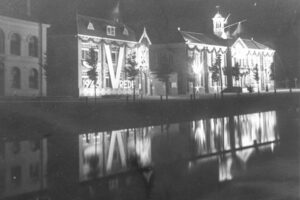
The town hall on Kerkgracht. Decorated for liberation, May 1945.
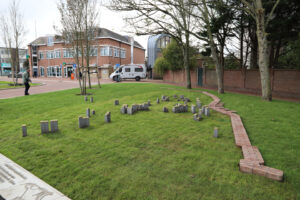
Memorial stones in the city park at Koningsplein. Unveiled in October 2020.