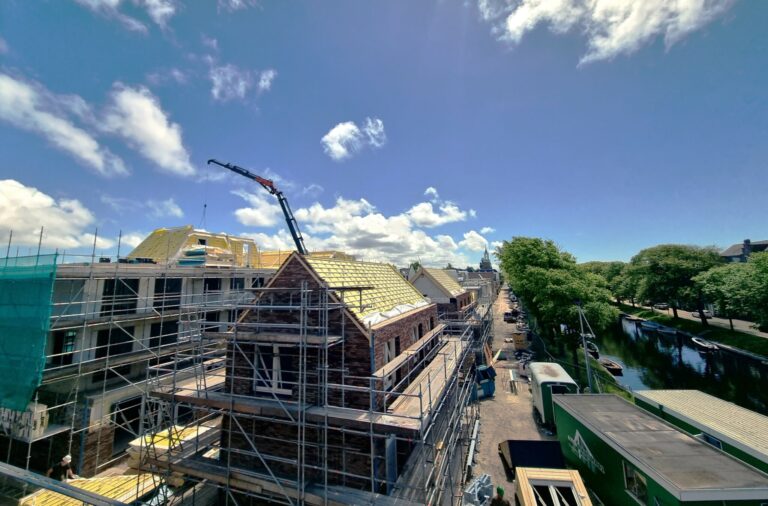
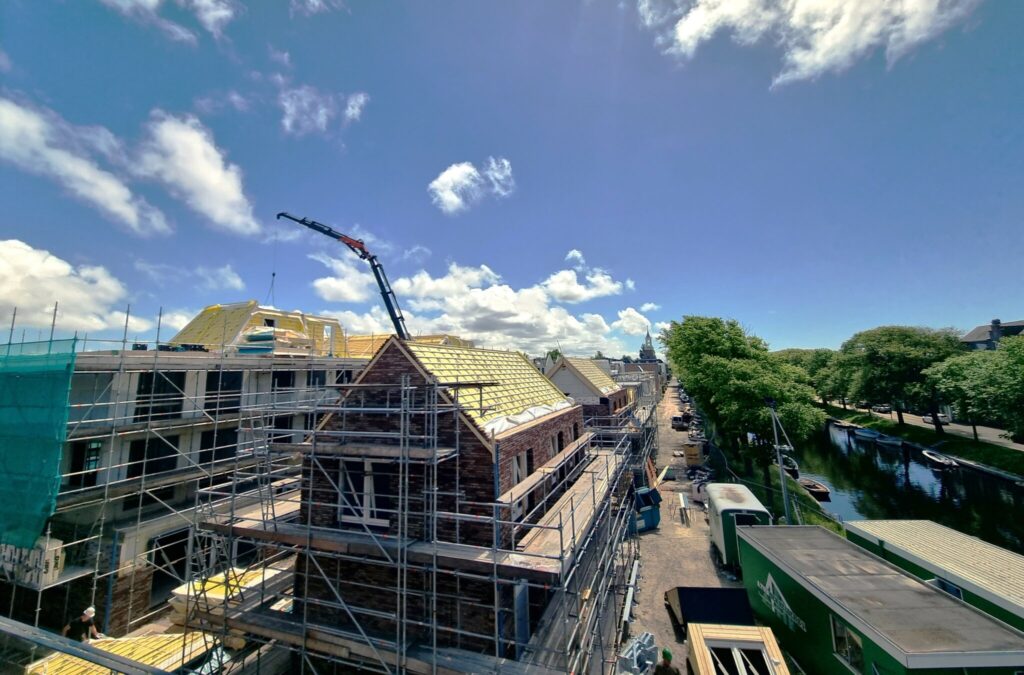
Project Molenplein. Woningstichting/Helder is realizing this under that title. Real estate currently 22 beautiful townhouses between Weststraat and the Keizersgracht. A unique location, a stone's throw from the sea. A A peculiar name, that Molenplein. Not least because there never a mill stood there. Why is it called that then? And what Does this place make it interesting?
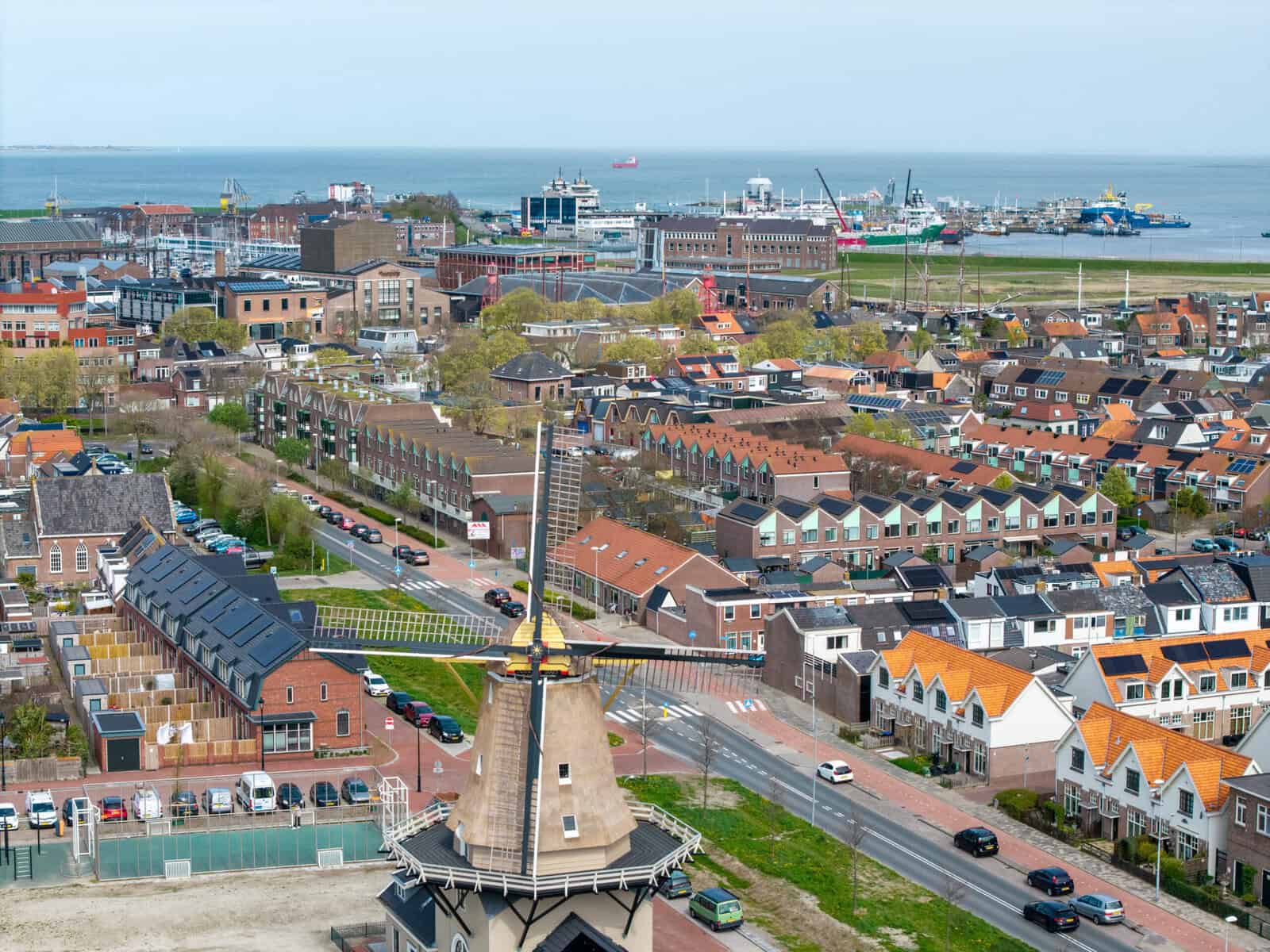
To begin with the answer to the first question: the mill to which the The name refers to stood directly opposite. The square was situated on the outer bend. of the Helders Canal. The De Eendracht mill stood in the inner bend. This was built in 1843, together with a miller's house and two small cottages. It was a so-called tower mill, which towered high above the city and mainly ground grain into flour to bake bread. Also the Molengracht and Molenstraat are named after this mill.
The Janzen brothers owned De Eendracht. And not only this one. mill, also of the sawmill De Goede Verwachting on the Fabrieksgracht. Housing Foundation/Helder Vastgoed is currently showing De Goede Verwachting rebuild, as part of the new Molenwerf neighborhood.
Heavenly fire
Windmills were vulnerable to lightning strikes at that time. Where the Goede Expectation in 1897, as a newspaper wrote, 'was by heavenly fire struck' and burned to the ground, that fate befell De Eendracht seven years earlier. Considerable damage was caused. And De Eendracht wasn't even original, but already rebuilt once, after it was destroyed by fire in 1850. The Eendracht It stood opposite the Molenplein until 1914, after which it was demolished. The square naturally retained his name.
That Molenplein itself played a prominent role in Den Helder for quite some time. After on December 18, 1865, the railway line between Den Helder and Alkmaar was opened, the Molenplein became 'the place to be': from 1867 onwards, the weekly Wednesday market takes place. A strange place for a market? Well, not entirely. The Molenplein was situated at the intersection of Kanaalweg and Hoofdgracht where in the nineteenth century a large part of public life in Den Helder played.
Chickens and goats
Moreover, the Helders Canal was a busy route for towboats and other scheduled shipping. Old photos show numerous ships in the outer bend lay moored. The supply of vegetables, fruit, sheep, chickens, and goats for The market on the Molenplein also took place partly via the Helders Canal. From 1900, the Molenplein took on a completely different role. That year, the State Higher Secondary School (RHBS, later called HBS) was put into use here. A for that time impressive building, where prominently along the Kanaalweg a large clock stood on a column, as if to remind the students that they especially had to arrive on time. The German occupiers took over the building in 1942. seized and demolished it in 1944.
Teacher training college
After the war, the Molenplein was neither a school nor a square anymore. That changed. early 1960s, when the Teacher Training College was built. The following followed here ‘'student teachers' the teacher training (m/f). The school name changed from 1970 in the Teacher Training College.
After the merger with the 'Pedac' in Alkmaar, the branch at Molenplein disappeared. – a fate that befell every Helderse program that partnered with an educational institution of outside the city merged. The school building was subsequently used for the University of Applied Sciences for Petroleum and Gas Technology, a branch of the maritime education. This college also disappeared after a merger. Finally, it received the complex still plays a role as a Study Centre for HAVO and VWO students of what when it was still called Etty Hillesum College. In 2007, it was definitively the end of the line.
The school was demolished and the site was eventually developed for phases 3 and 4 of Molenplein project: Dijckzicht care center and Over 't Wad residential complex. Currently, the 22 city villas being built constitute phase 2 of the project. Molenplein, with which the entire area along Weststraat will soon be filled. The name Molenplein therefore means: living in a place with a rich history.
RONALD DEN BOER