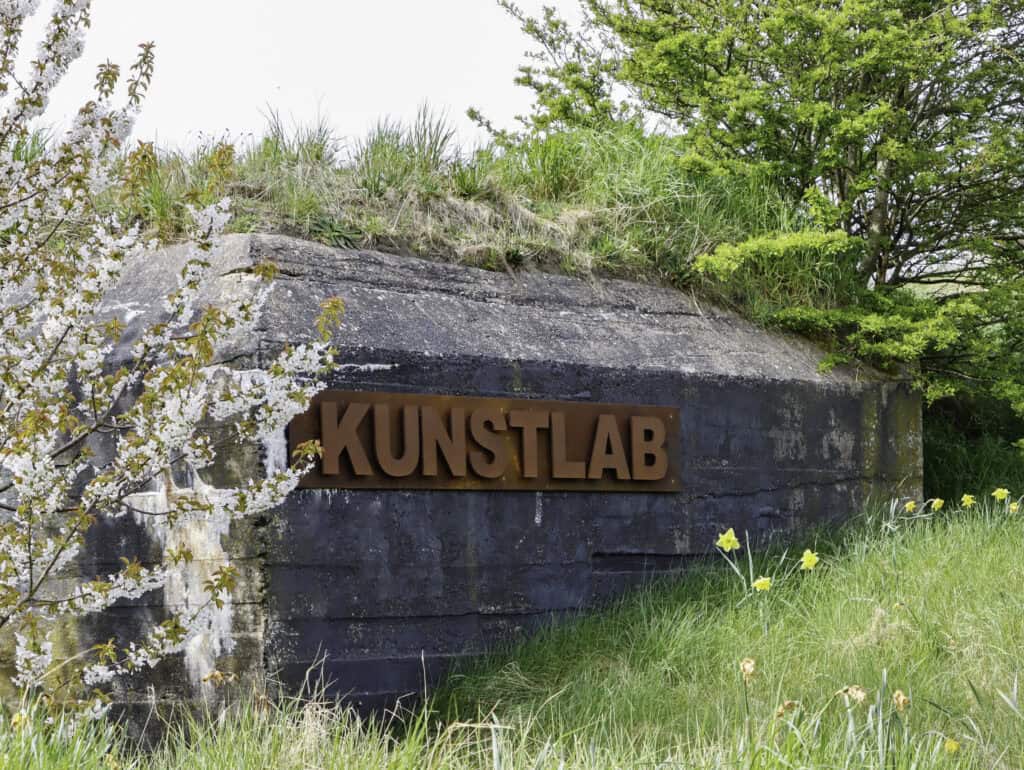
Den Helder is situated in a special place, embraced by the sea on three sides. This location brought the city much. The navy established itself here, the port grew into an important link for the Netherlands, and generations of residents lived with the sea as their neighbor. But this same strategic location also made Den Helder vulnerable during wartime. During the Second World War, the city became part of the Atlantic Wall, the defensive line the Germans built along the European coast. Bunkers appeared everywhere in the landscape.
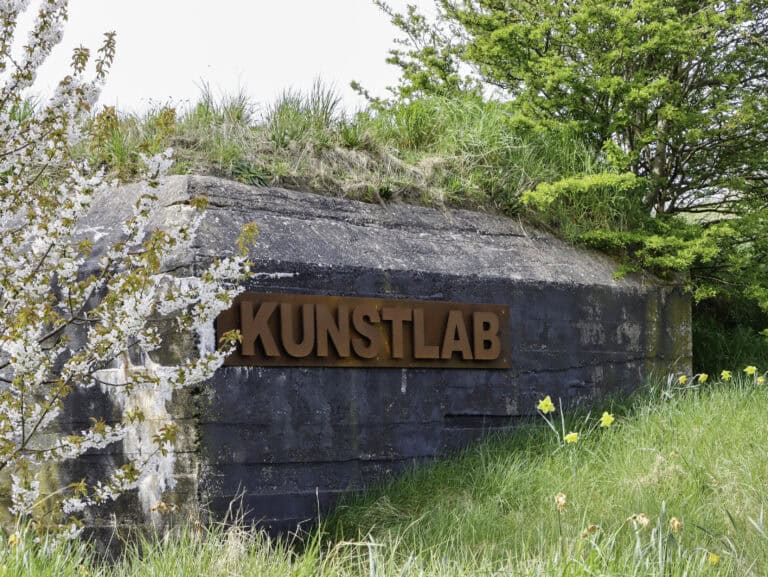
Many of those bunkers still stand today. Sometimes hidden in the dunes, sometimes concealed under the sand. In one place, they even acquired a completely new meaning: De Nollen.
Anyone walking across De Nollen today sees a landscape full of artworks, steel sculptures, painted spaces, and surprising vistas. What many visitors do not know is that dozens of bunkers still lie hidden beneath that art landscape. Not as isolated reminders of the war, but as part of the artwork itself.
A boy from Huisduinen
To understand that story, you actually have to go back to Huisduinen.
Artist Ruud van de Wint grew up there. Long before he became known as the creator of the monumental artworks in the House of Representatives, he was a boy who roamed the dunes with his older brothers. Like so many children of that time, they discovered the abandoned bunkers left behind after the war. They explored dark corridors, hidden spaces, and underground passages. Places that were simultaneously exciting, mysterious, and fascinating.
Volunteer and guide Martin Nieuwerf thinks that those experiences never completely let go of Van de Wint.
“When you look at his work, you see the interplay between dark and light recurring time and again. You see tunnels, passages, and spaces that have an effect on you.”
Years later, those childhood memories would return in a special way.
No museum hall
Ruud van de Wint grew into one of the most important Dutch artists of his generation. Millions of Dutch people know his work without realizing it. The monumental murals in the plenary House of Representatives, for example, are by his hand. Yet he was often described as the most famous unknown artist in the Netherlands.
He created his greatest work not in a museum or government building, but in Den Helder.
When Van de Wint acquired De Nollen in 1980, he did not find an empty piece of land. There were some 26 bunkers scattered across the site. The fire brigade practiced there, a motocross club rode around, and equipment was stored in various locations.
Where others saw a messy site, Van de Wint saw possibilities. He did not want to create art that had to adapt to a museum hall. He wanted to create spaces that became part of his art. For that, he literally needed the space.
And he found it at De Nollen.
Bunkers as building blocks
Remarkably, Van de Wint decided not to remove the bunkers. He used them.
Some slowly disappeared from view as the landscape changed. Others became part of new works of art. Still others formed the foundation upon which new ideas could be built.
A fine example is the Harmonica, one of the largest artworks on the site. The enormous steel work weighs over 27 tons. Thanks to a sturdy bunker foundation, it could be placed precisely at that location. What was once built for defense now literally supports a work of art.
The bunkers recur in other works as well. Bunker spaces are still located beneath some artworks. In Aether II, an old bunker forms the basis of a monumental painted space. And in Eidolon, visitors walk through dark corridors towards the light.
Those who know, see the bunkers everywhere. Those who do not know, primarily experience a landscape in which art, nature, and history seamlessly merge.
A new meaning for even more places
De Nollen does not stand alone in this. In several other places in Den Helder, locations with a military or maritime history were given a new lease on life. Willemsoord transformed from a Royal Shipyard into a place for culture, hospitality, and events. Forts became museums and meeting places. Something similar happened at De Nollen as well.
Perhaps that is typical of Den Helder. A city that doesn't hide its past, but makes something new out of it. Not by erasing history, but by adding a new layer to it. At De Nollen, you can perhaps see this reflected at its most beautiful.
You have to experience it
According to Martin, that is also where the strength of De Nollen lies.
“Many people think they know De Nollen because they have often driven past it. But as soon as they step onto the grounds, they discover that it is very different from what they expected.”
Children are often immediately fascinated by the tunnels and hidden spaces. Adults, on the other hand, are moved by the scale of the artworks, the colors, and the silence.
Martin himself still remembers his first visit well.
“I could hardly sleep that night. So much was going on in my head. Because of the shapes, the colors, and the spaces. I kept thinking about it.”
Perhaps that is what makes De Nollen so special. It tells not only the story of an artist, but also the story of Den Helder itself. A place where the sea, history, and imagination come together in a landscape you won't find anywhere else.