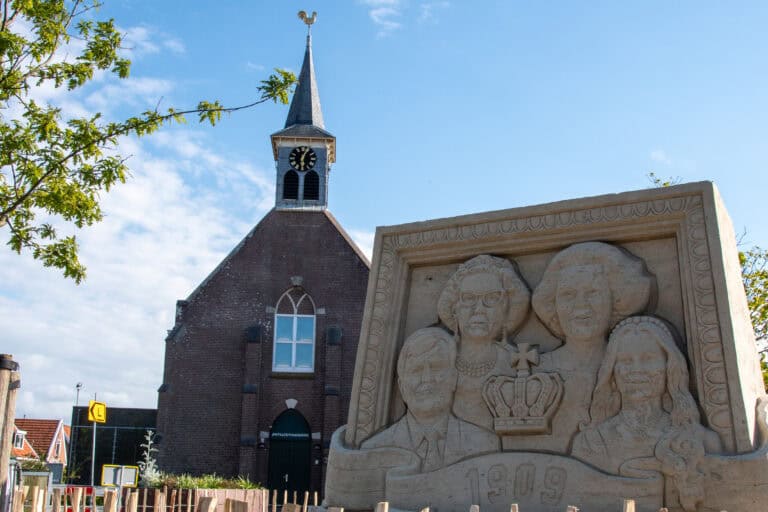
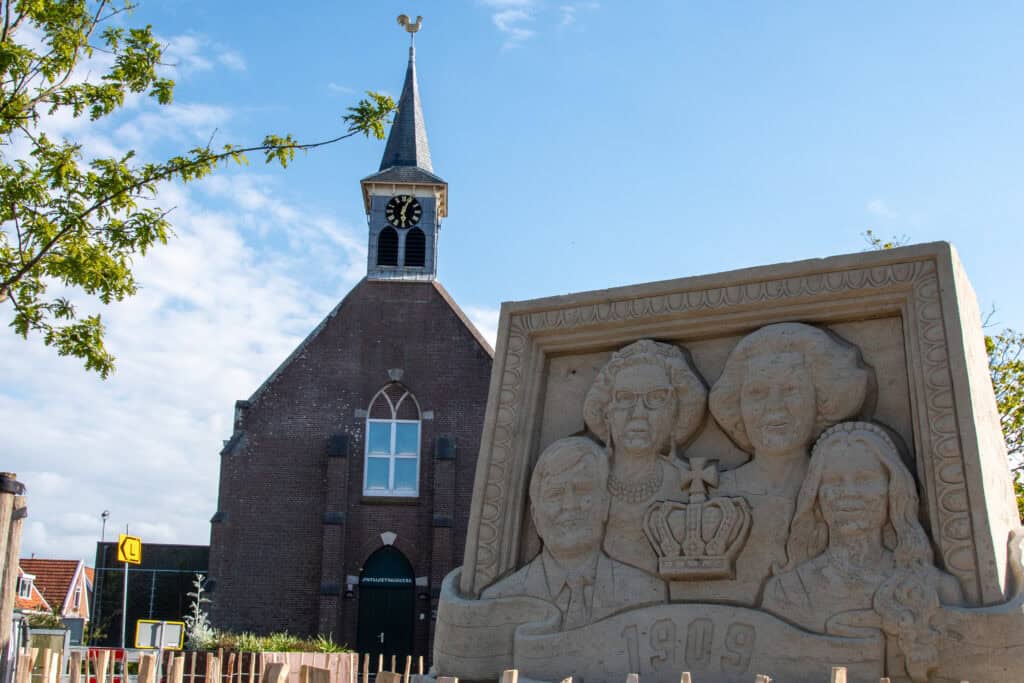
Julianadorp owes its name to a letter from 1909. More than a century later, a sand sculpture of the royal family in Loopuyt Park refers to that special history of the name. In the video, Erwin Mosk explains why the village was first called Loopuytdorp and eventually received the name of Princess Juliana.
A village that grew out of the polder
The Buitenveld used to be located where Julianadorp now stands. The area lay outside the dikes of Huisduinen and Den Helder and flooded regularly. After the construction of the North Holland Canal and the adjacent dike in 1825, the Koegras polder was formed.
Mr. Pieter Loopuyt purchased the polder from the State in 1849. A school for the children of local farmers was established in the center of the area. A settlement slowly grew around that school, which was initially named Loopuytdorp.
A letter to Queen Wilhelmina
Pieter Loopuyt junior considered it too much of an honor to have the village named after his own family. After the birth of Princess Juliana on April 30, 1909, he came up with a different proposal.
On October 20, he wrote a letter to Queen Wilhelmina asking if the village could be named Julianadorp. Permission was granted as early as November 3. The family name was preserved in Loopuytpark, the square in the old village center.
During the Second World War, the name Julianadorp temporarily disappeared. The German occupiers had the village renamed Loopuytdorp again, because references to the royal family were not permitted. After the liberation, the village regained its familiar name.
More than one sculpture at Loopuyt Park
The royal family is just one of the subjects rendered in sand at Loopuytpark. Around the bandstand stand three more large sculptures that showcase different facets of Julianadorp. In this way, the historic square forms a small open-air gallery in the middle of the village this summer.
Sand artworks can also be found at three other locations. At Landal Beach Resort Ooghduyne, you can see sculptures about life with the wind, among other things. The design by the winner of a drawing competition is also located there, which has been executed by the sand artists as a genuine work of art.
At beach bar Zee van Tijd, the sand art is given a special setting. Special sand was brought to the beach for the sculptures.
Create your own cycling route
There is no mandatory starting point. You can visit one location or put together a route past all four places yourself. By bike, it takes about one to one and a half hours to complete the full loop, depending on how long you spend looking at the artworks.
Along the way, you pass through various parts of Julianadorp: from the old village center and the recreational area around Ooghduyne to the beach. Furthermore, there are several places to eat and drink along and around the route. This makes it easy to combine the round trip with coffee, lunch, or a visit to the sea.
Anyone who visits all the locations sees more than a collection of individual artworks. The sculptures reveal different facets of Julianadorp: the unique name, the polder landscape, life with the wind, and its location by the sea.
See the sand art for yourself
The sand sculptures of Zandspektakel Julianadorp are free to access and can be viewed until mid-August. You can visit the four locations by bike or choose for yourself which places to combine.