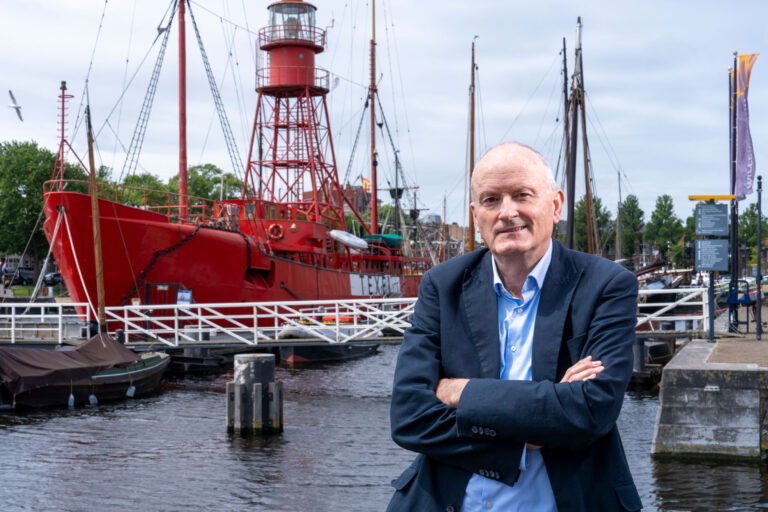
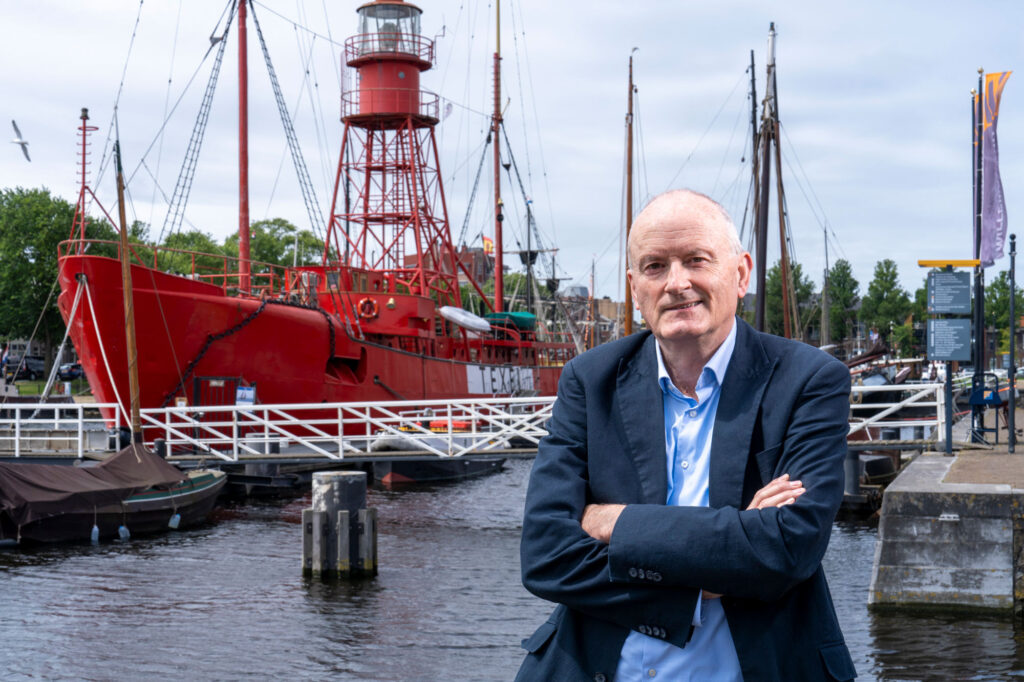
He loves Willemsoord. Here, his love for maritime heritage and old crafts come together with the history of the city and his own history as a naval officer. Still in his final year as 'Deputy Commander of the Netherlands Defence Academy, also VOKIM', he joined the newly established Willemsoord Museum Harbour Foundation. ‘We lived at the palace, as it is so beautifully called, the service quarters. Willemsoord was our backyard. My wife Melany regularly went for walks there with our little dog Charlie.’ He laughs. “Between the cinema and the Bonaire dock lies an old bunker. Years ago, a mural was painted on it for SAIL. Melany went to take a look. The painter then immortalized Charlie at Willemsoord.”
Character
The Museum Harbour Foundation is an umbrella organization that brought together the foundations for Nautical Monuments, the Lightship, and the Bonaire, among others. This simplified communication and agreements with Willemsoord BV, as well as those with the municipality. The foundation's goal is just as close to his heart now as it was then. “It is incredibly important to cherish the artisanal-maritime character of Willemsoord,” he says. “We must preserve that and strengthen it where possible. That is why we drafted a manifesto together with the municipality stating that this character must remain a common thread in the development and utilization of Willemsoord's potential.” He knows from experience that this is not always possible. “In the spirit of 'use it or lose it,' you sometimes have to make choices that do not immediately fit within that artisanal-maritime framework.‘ For instance, the new Helderse city hall was completed in 2023. ’The decision came as a surprise to us, and the first artist impressions put us on the wrong track. The slipway was barely recognizable in them, but completely unusable for ever laying up a ship again. Fortunately, that idea never really became a plan, but at the time, it was a confirmation for everyone who feared the arrival of the city hall. 'See, end of Museum Harbour,' people thought. But once the decision had been made, we said that we had to make something beautiful out of it together.”
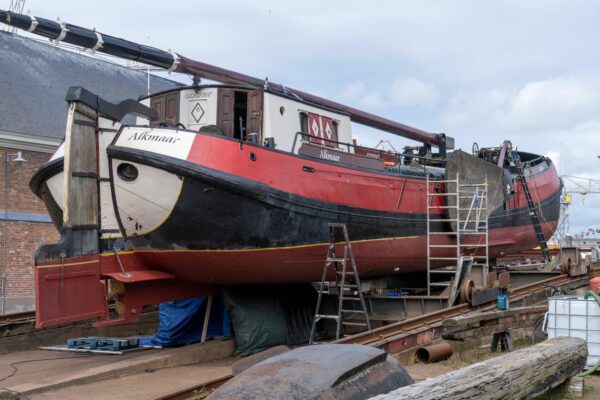
Why was that fear there? City Hall is the place where the city is governed and where all residents gather. It also makes sense to place it in the area where the history and character of that city are most strongly felt. Michiel: “On a philosophical-abstract level, certainly. ‘Right in the city’s DNA. We can hear the historical heart beating,’ was said. I understand that completely. But from our perspective, we had different ideas.” Ideas that failed. “To be honest, these buildings had been standing empty for a long time and it wouldn’t be long before they would collapse from dilapidation. Serious operators were sought who would fit the character of Willemsoord, but that never succeeded. By giving it this purpose, the municipality remained the owner. The investment of public funds in the restoration therefore also returns to the community. That seems like a good structure to me anyway. And I cannot say otherwise: both buildings have been very skillfully restored. It has turned out exceptionally beautiful and is gratefully used by many people.” He laughs: “It would be nice if a few more employees came by bike, so there would be fewer cars parked.”
Value
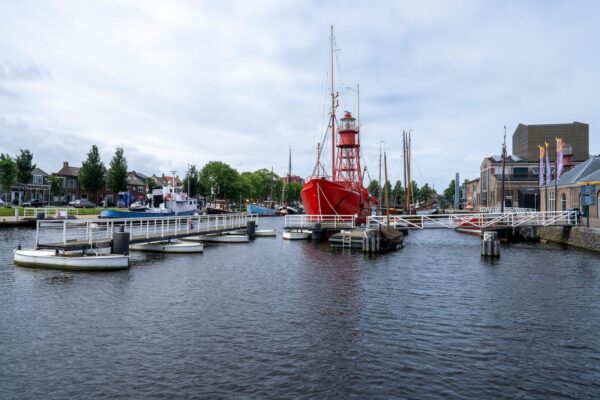
The most beautiful spot in Willemsoord is all of Willemsoord, he says. “Actually, at the top of one of the monumental cranes, so you can see everything. The Ferris wheel is an option too, of course. Or otherwise, the corner in front of the Schipperscafé. You stand with your back to Willemsoord, but you can still see the water, the promenade, and the ships. A really great spot. Then you turn around and see the lightship, the quay, the café, and the slipway.”
A sweeping view over Willemsoord reveals just how much is actually happening on the site. From hospitality to museums, from craftsmanship to entrepreneurship, from history to new technology, and from industry to administration. Michiel explains: “The importance of Willemsoord is multifaceted. With the exception of the flower bulbs, you will find everything here that makes Den Helder Den Helder. Hans Broekmeulen gave a wonderful interview in the newspaper in April 2021 upon his departure as director of Willemsoord BV. In it, he said: 'Try to imagine Den Helder without Willemsoord.'" That is actually impossible. So much would be lost. A few years ago, a report was commissioned by Willemsoord BV regarding the economic added value of the area. I was very pleased with that, because for a long time there was not always confidence that this value existed. It was called a bottomless pit. Until that report, people essentially only looked at the balance sheet of Willemsoord BV and not at what it brought to the city and its inhabitants, for example in the form of employment and tourism. From a purely economic perspective – and I am not even talking about the societal value yet – that generates millions for the city. For the development of the area, it is so important to keep seeing that.‘
Zeestad plays a crucial role in this. Michiel: “They have a very important task to make this beautiful area even more beautiful, and in a way that does justice to its specific character. That actually applies to the entire city. I am glad that a structure was chosen in which one party holds that coordinating role. A municipality cannot do that on its own, and neither can Willemsoord BV. You need one party with the brains and hands to lead these kinds of large projects. And of course, you could hire expertise for each individual project, but I am a fan of the structural agreement with an organization that is part of the city. Zeestad has proven itself in that regard. They know the city and know how things work. Naturally, it often involves matters that everyone has an opinion on. Zeestad knows what sentiments prevail and how to deal with them. Without them, we would never have gotten this far.”
Darling
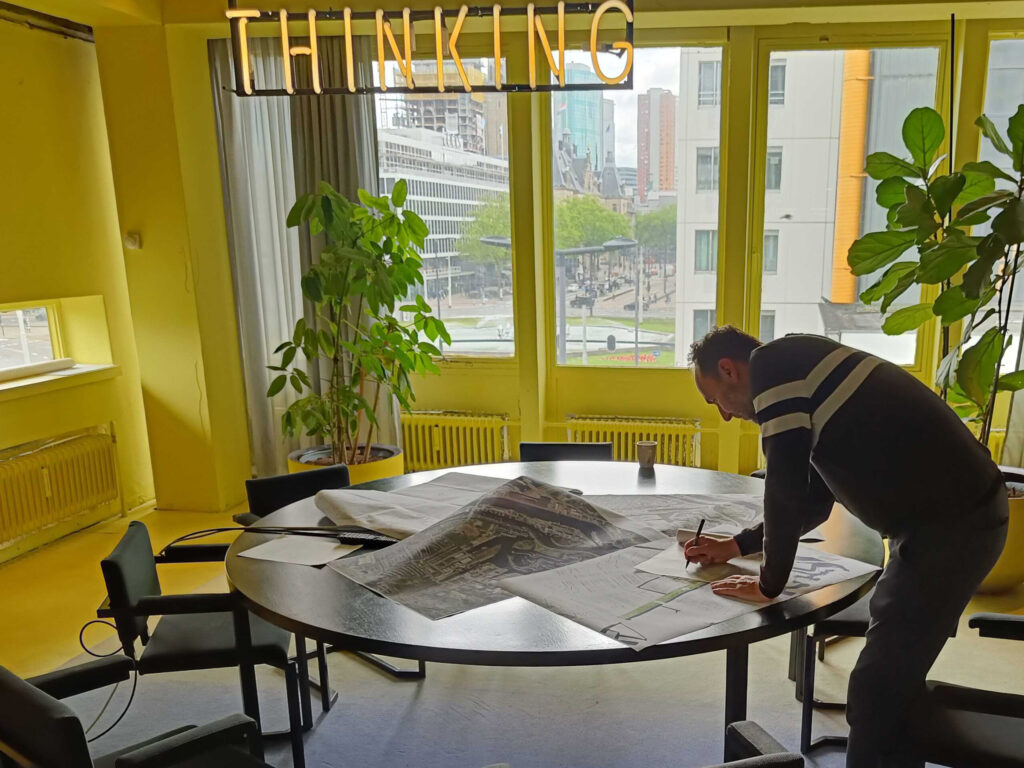
He always remains critical. “Of course. The Museum Harbour Foundation stands for a vision. I don't necessarily need the Kleine Werf hospitality project, for example, but I also have confidence that the parties will work it out together, precisely because good agreements have been made. As far as I'm concerned, the pedestrian and cycle bridge to improve accessibility to Willemsoord can go ahead as soon as possible. And I hope for a great collaboration with the Ministry of Defence for the development of Buitenveld. That offers so many possibilities for things like hotels, short-stay accommodations, education, and access from that side.” He envisions things and pulls out his iPad with a map of the area. “Look at these quays, for instance. You can do some really beautiful things there. It would be good to involve the Museum Harbour Foundation in thinking about their development and use.”