Directly
Hundreds of local residents gathered for a neighborhood meeting with the municipality. “The aldermen entered through the front door, but left again lightning fast through the back door after the meeting. Everyone was so angry. They were all homeowners. There were many Wervians living here. They had worked hard to be able to buy a home for themselves. The municipality had really trampled on their souls.” Initially, part of the demolition plans were reversed by the municipality. What remained was the construction of the Northern Ring Road. “As residents, we did not agree to that either.” A number of them, including Riet, set about filing an objection. “We didn't make it at the municipal council, nor at the Provincial States, and then we went on to the Council of State. All in all, it took at least eight years, but the Council of State ruled in our favor."
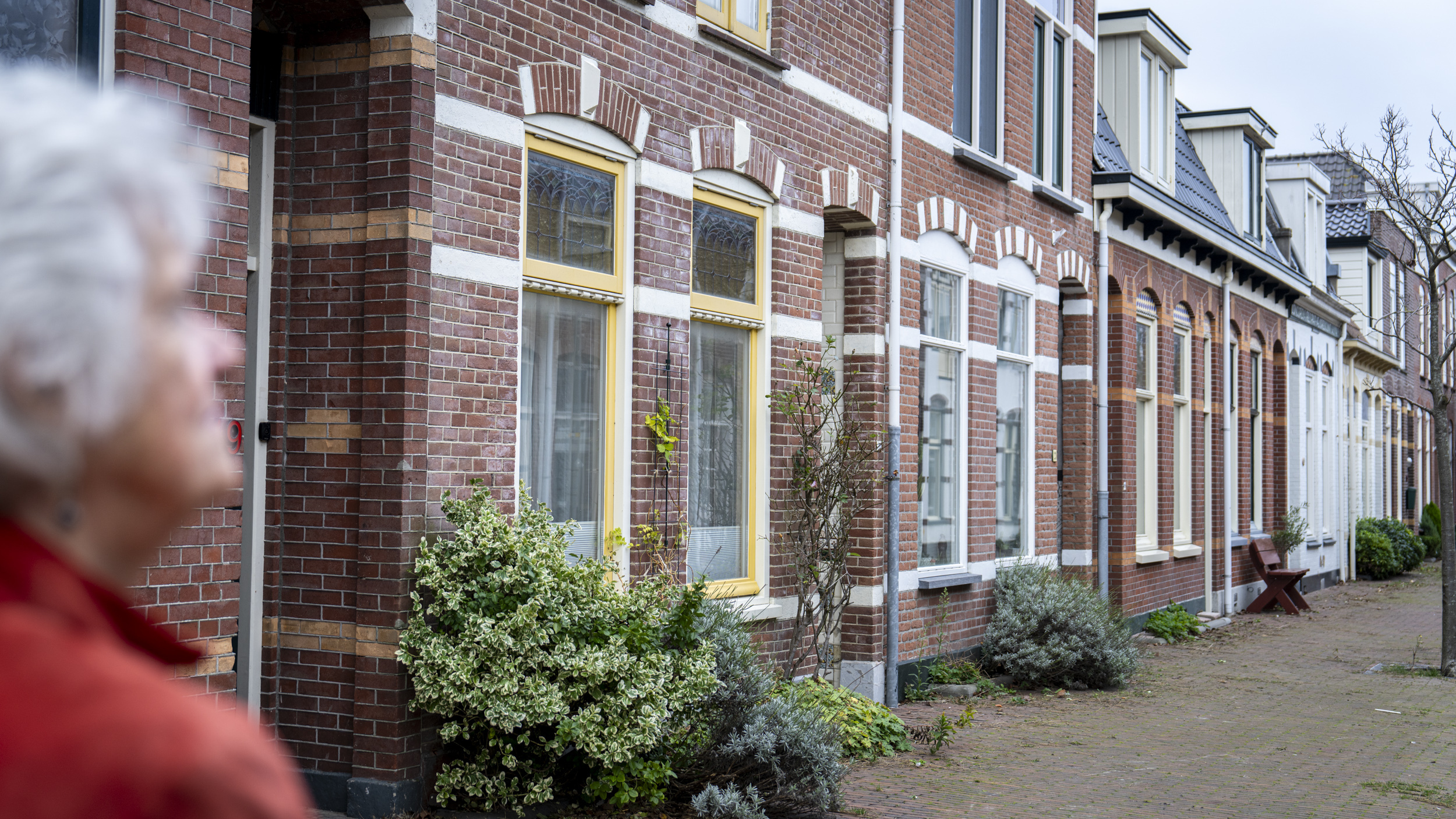
In the meantime, those years had not done the neighborhood any good. Riet: “People naturally opt for security, so quite a few people sold their houses to the municipality anyway. All those properties were demolished. It was a very empty state. Others didn't dare do too much to their homes, for fear that it would be for nothing. But while awaiting the ruling of the Council of State, we had already sat down with students from the Academy of Architecture in Rotterdam. Our neighborhood became an exam assignment, and so we received a complete urban planning scheme as a gift. The gateways from Vroonstraat, for example, were an idea of the residents, just like the designs of a number of houses in the neighborhood. That is how we thought it all through together.” That sounds as if they had a lot of confidence in a good outcome. “That is indeed the case. And the fact that we had really good plans may also have played a part in the Council of State's decision. But of course, we also knew that it would all take much longer if we only started with a development plan after the ruling.”
A neighborhood for everyone
The municipality could only embrace the plans. Funding came from The Hague for residents who wanted to renovate their homes, and the neighborhood got a new community center. “The municipality proved to be very good-natured in that regard. And the Housing Foundation then realized all those new homes.” The Helderse Courant lies before her. On the front page is a report about the decision to replace the Housing Foundation's management. “I find it truly dramatic,” she says. “Right in the middle of that whole urban renewal process. When you see everything that still needs to be done... I don't understand it at all.” She is not alone in this. Den Helder shows itself to be combative once again. Riet: “You immediately see all kinds of initiatives emerging again from people who want to push back.”
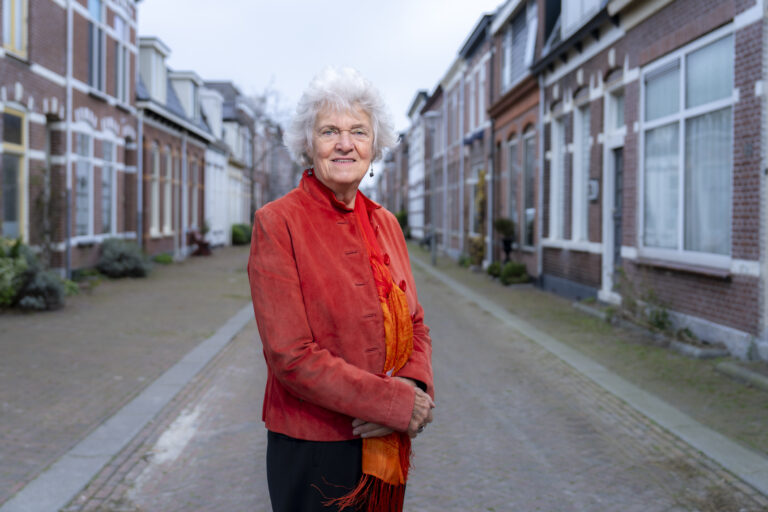
While the neighborhood was being renovated, Riet and her husband decided to take the next step. They sold their house and bought a larger home in the same neighborhood. “We really wanted to stay here. It is a neighborhood where 'everyone' lives. From the unemployed and unskilled to the university-educated. We love that. I wouldn't be able to get used to a posh neighborhood.‘ When things calmed down a bit, Riet and her husband were able to focus a little more on 'ordinary' life. For Riet, that meant turning her 'hobby' into her profession. She went to the social academy to work as a community worker. Over the years, she also served on the city council for the PvdA, the board and the Supervisory Board of what is now called Scholen aan Zee, and was chair of the Kinderdagverblijven Foundation. ’Through that, I got to know and appreciate the city even better. And through my hobby of photography. I have created photo series of, among others, the Visbuurt, Helderse seniors, Willemsoord, and of course the bulb fields.”
She has been retired for ten years now, but her head and heart are still in the city. “I am on the advocacy working group of the Stichting Werkgroep Centrum. That is the same group with which we lodged an objection back then. Together with them, I sit on the Oostsloot/Centrum sounding board group, as well as the sounding board group for the Dijkkwartier, and again with Werkgroep Centrum in a consultation group with the municipality, Zeestad, and Woningstichting. In this group, we discuss all new construction plans in the Center.” So, when it comes to citizen participation, quite a lot has changed. “Absolutely, we have constructive dialogue, and we are actually being listened to now. That is very nice. It is a relief that you no longer have to fight to be heard.”
City life and tranquility
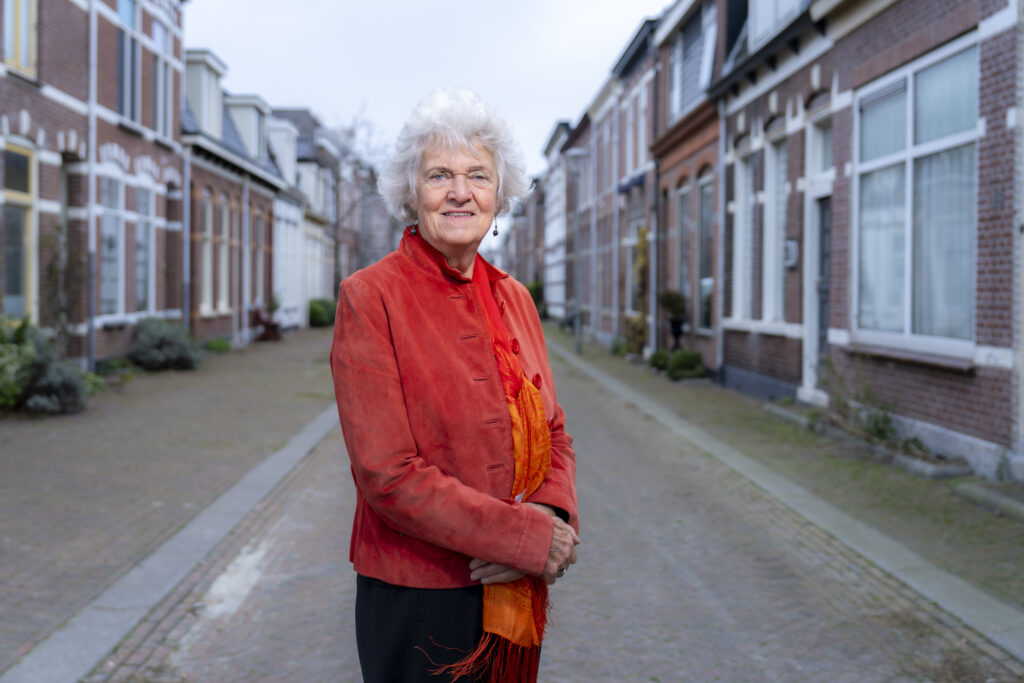
Riet and her husband actually didn't want to leave Amsterdam so many years ago. “I was crying in the moving van,” she says. But once they were settled here, they truly did everything to secure their place. Why was this neighborhood so worth it? “Just look at what we have!” says Riet. She points to her green backyard. “All those beautiful city gardens. I have my own little forest right in the middle of the city. Furthermore, we have a very nice house, close to the shops and close to the dike. On a nice day, I walk over there with a chair and a book and go sit at the foot of the dike to read. The children and grandchildren also live in Den Helder, and we are close to the station. It is the combination of city life and peace and quiet. We are close to the hustle and bustle, but the street is dead silent.” So, they have absolutely no regrets. “You have to learn to love a new city. By dedicating myself to the neighborhood and society, I have settled in here. When we had to leave the squat in Amsterdam, we even tried to buy a houseboat on the Amstel. We couldn't get a loan for that. Sometimes I wonder how my life would have turned out if that had worked out. But you know, the moving truck driver said at the time: 'You are crying over Amsterdam now, ma'am. But if you were to leave Den Helder one day, you would be just as sad.' And that is how it is. I never want to leave here.‘