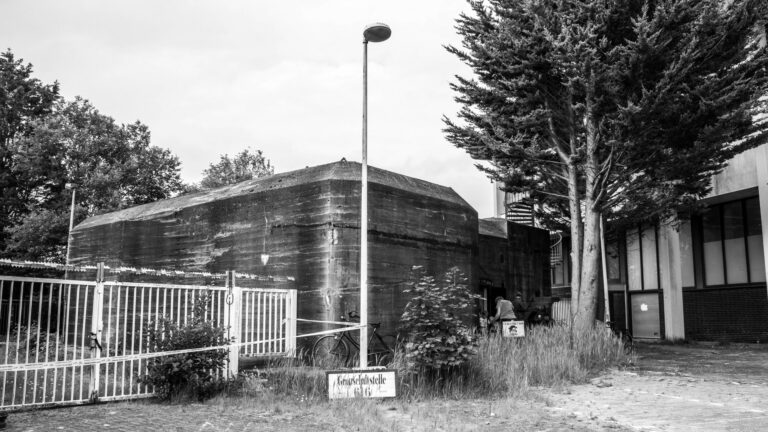
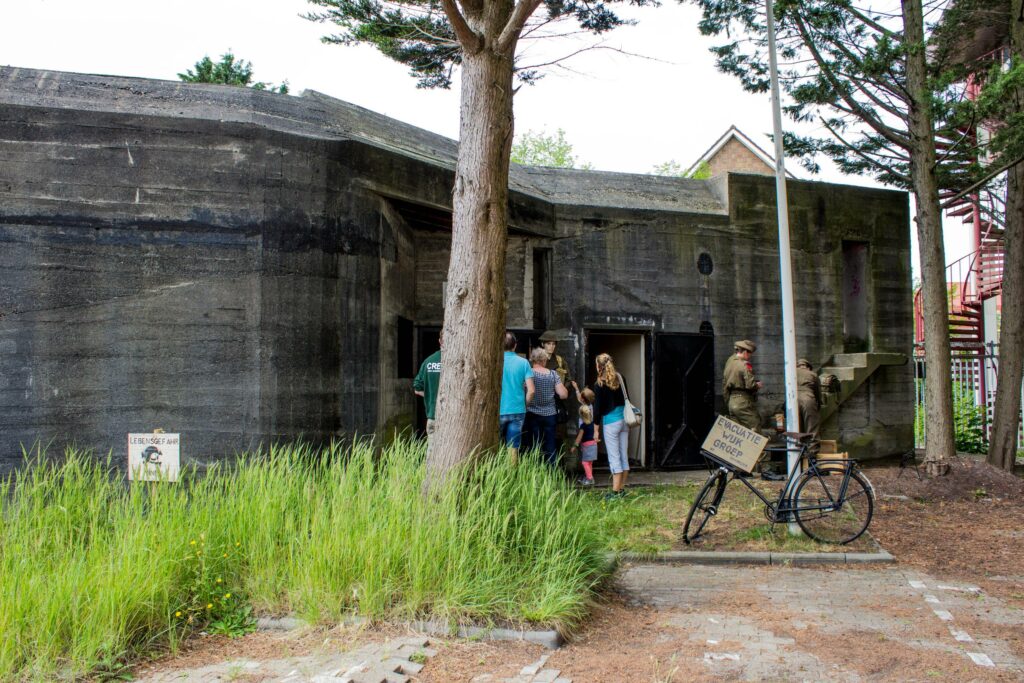
In this section, each issue features a section of the Den Helder Defence Line. The Den Helder Defence Line is part of the Atlantic Wall, a 5,000-kilometer-long defense system stretching from Norway to Spain that was intended to protect Western Europe from attack from the sea during World War II. The most bombed city in the country still has many military remains; this time, the focus is on the Telephone Bunker.
Nearby, next to station Den Helder, stands a type 616 telephone bunker, also known as a communications post, with an attached Tobruk (an extension with a machine gun emplacement). It is one of the last three remaining in the Netherlands, and, unusually, it was built in mirror image. Communications between the various defense posts surrounding Den Helder were handled in this bunker. After the Second World War, a post office was built in front of the bunker, incorporating the architecture of the reconstruction, creating an interesting, historically diverse ensemble of buildings for communications (postal, telephone, and telegraph).
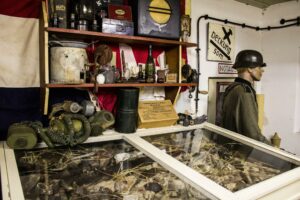
During World War II, the bunker was built as part of the national defense system and as a central communications bunker. The type 616 bunkers, in addition to a telephone exchange and transmitting equipment, include a space for storing cable reels, accessible separately from the outside. The bunker also has a storage room with switch cabinets at a junction of the military telephone network. The top of this concrete colossus was covered by a camouflaged roof, which was demolished after the war. The interior of the Helderse bunker remains virtually intact and unchanged.
Today, the 616 is a small museum with a large collection, and the bunker is designated a national monument. This means, among other things, that the bunker is preserved for various reasons, such as its cultural-historical value, rarity, and architectural and military history. The bunker is now prohibited from demolition, a matter that was still on the agenda less than 20 years ago.