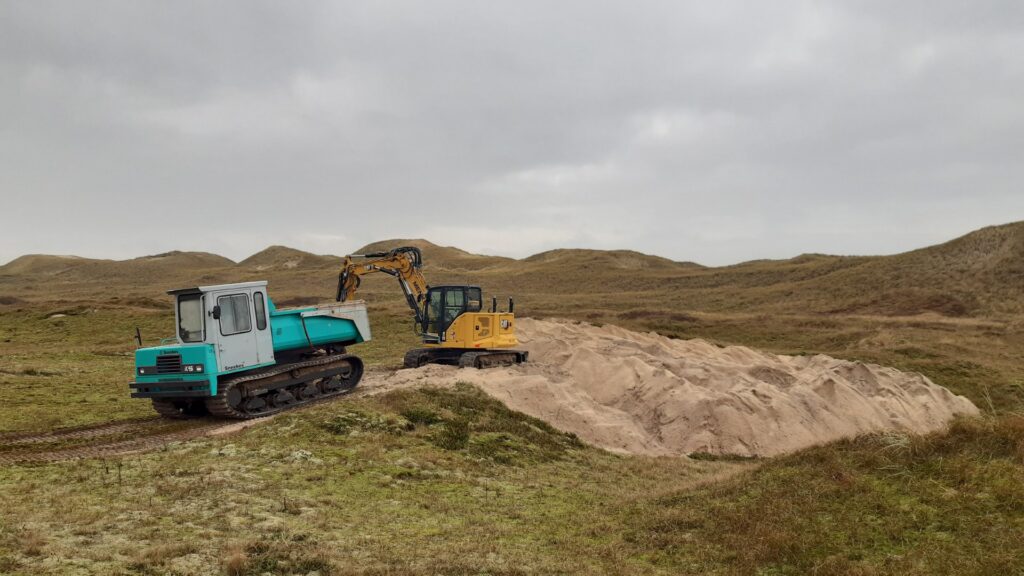
From late January to mid-March, Landschap Noord-Holland will resume work to give nature in the Noordduinen region a positive boost. At over 70 locations between Julianadorp (the Zandloper beach) and Den Helder (Duinoord beach), large and small Japanese rosehip hotbeds will be removed to create space for rare native plants and animals. Several of these locations will then be planted with beachgrass.
Forest ranger Tim Zutt: "The work is a follow-up to last year's work to further help nature recover. Invasive exotic species like the Japanese rosehip can quickly take over large areas of dune. Dynamic dunes provide a 'home' for rare dune butterflies, the dune pansy, the northern wheatear, and the endangered rabbit population: they are incredibly dependent on dynamic dunes.".
Cycle paths remain accessible, but we ask cyclists to be mindful of the ongoing work. This will be signposted on-site. Sneekes, a company from Schagerbrug, is carrying out the work. Not all Japanese rosehip has yet been eradicated from the Noordduinen. We will continue to carry out work in the coming years.
The North Dunes are part of the European Natura 2000 protected areas. The work will help preserve this protected dune landscape for everyone to enjoy. A species-rich landscape is truly something to cherish! The work is being funded by the Province of North Holland through its Nature Programme.
More information can be found at: www.landschapnoordholland.nl/natuurherstel/noordduinen