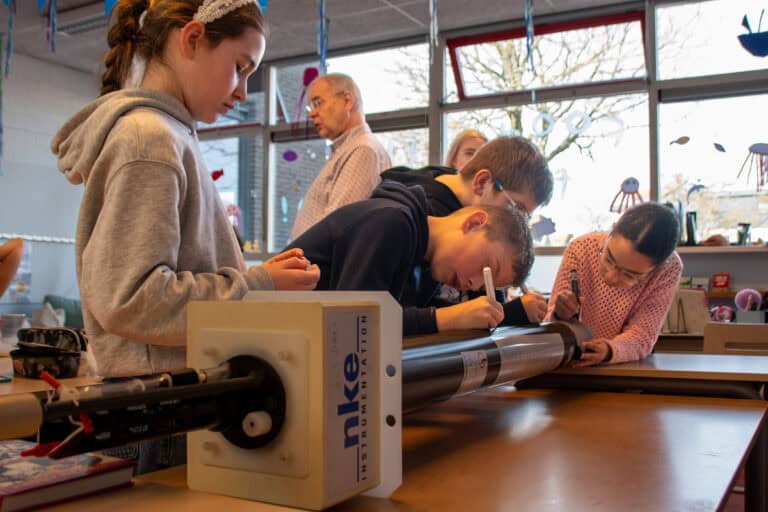
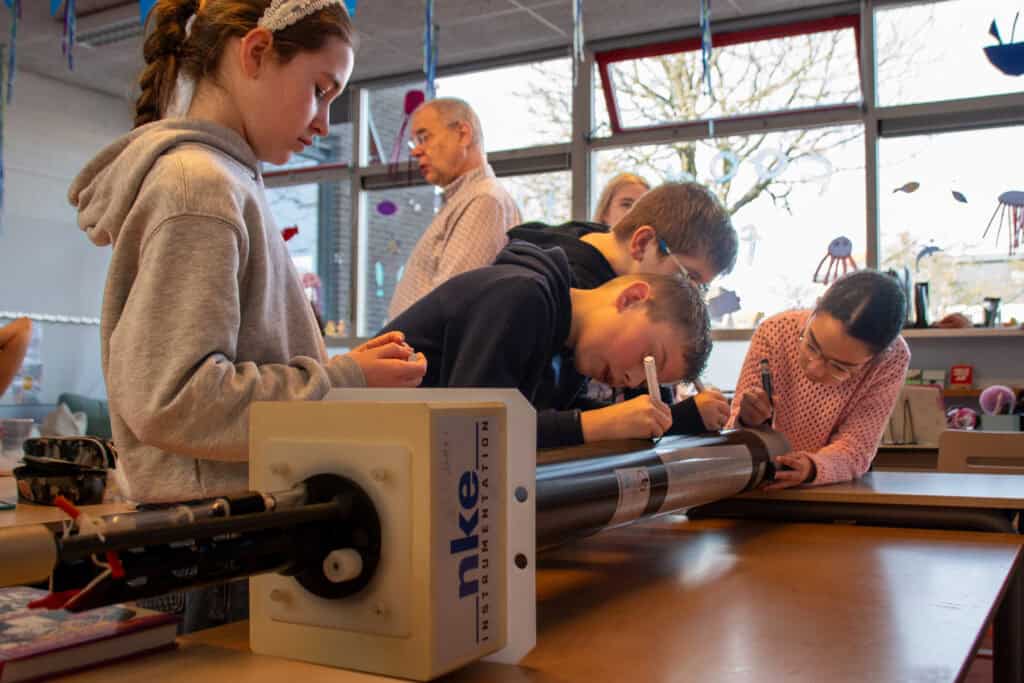
Students from Group 6 of the Jac. P. Thijsseschool recently put their names on a special measuring instrument. Not on a notebook, poster, or project, but on an Argo float that will soon be going into the sea. Together with the children from Villa aan Zee, they adopted this measuring buoy. Over the coming years, the float will collect data on currents, temperature, and the salinity of the seawater in the ocean.
Underwater
During a guest lecture, Taco de Bruin from the Netherlands Institute for Sea Research took the students into the world beneath the water's surface. He spoke about fresh and salt water, warm and cold ocean currents, and how they work together to keep the oceans in motion. “The ocean is much more than just one big tank of water,” he explains. Below the surface lie mountains, valleys, and currents that influence the climate and life on Earth.
The Argo-float will soon descend into the ocean, collect data, and then rise back to the surface. There, the instrument transmits the measurement data to researchers via satellite. Thousands of these floats are floating in the sea worldwide. An Argo-float operates independently for years, thereby contributing to global ocean research.
Real data
For the students, it doesn't stop at just one guest lesson. They will soon be able to monitor their own float online. Not only this school year, but also in the years to come. Even when they are already in secondary school, the measuring buoy continues to collect data.
According to Tosca Tamis, a teacher at Scholen aan Zee, the float can also be used in secondary education later on. For example, in biology, geography, mathematics, or statistics. The Argo float also offers opportunities for final projects. Students can then conduct research using data from a measuring instrument they are already familiar with from their primary school days.
Continue learning
To make that data truly usable, Remy van den Dungen from Vonk is helping to think about the next step. The measurement data from an Argo float can be technical and extensive. Therefore, they are looking at how that information can be made clearer and more understandable for students. “It needs to be reduced to something small,” says Remy.
This gives the project a place in the continuous learning pathway of Blue Schools. Within Blue Schools, childcare, primary schools, secondary education, vocational education, and knowledge institutions collaborate to educate children about water. A pupil who is introduced to the float at primary school may encounter the same measuring buoy again later at Scholen aan Zee or at Vonk.
Future researchers
For Taco de Bruin, that introduction to the ocean is particularly important. Many people know little about what happens beneath the water's surface, even though the sea has a major influence on the climate and our daily lives. By introducing children to real ocean research at an early age, not only does their knowledge grow, but perhaps their outlook on the future as well.
Perhaps the float will even raise new questions later on. About the ocean, about technology, or about the underwater world. And who knows, a future researcher might look back on this moment, in a class in Den Helder.